



Why would a person from the Blue Ridge Mountains write a blog about a monumental life between a Gaelic woman and a Norman man that occurred over 700 years ago? Primarily, the characters are dynamic, the results are world changing, and the tale is a story of all of us. Secondly, these are my people. By DNA testing, I am 38% Norman and 35% Celtic and Gaelic. The factual story cannot be told because of the limitations of the thirteenth century. I will use as much fact that is available, color in recorded history and shade with likelihoods.
Three thousand years back there was land on an island sitting west of a storm savaged basin of the North Sea and east of the Atlantic Ocean which slammed into long inlets and satellite islands. To the south were the remainder of the island, rolling lowlands and inlet rivers. To the north were rugged cold islands. Someday it would be called Scotland.
Eight hundred and fifty miles east in Hallstatt, Austria, and many years later, Johann Georg Ramsauer (1795–1874) began excavations when workers uncovered ancient graves during mining operations. Johann was a mine manager in a salt-mining town of Hallstatt, Austria. Ramsauer documented everything with detailed notes on weapons, jewelry, pottery, and textiles. He noted the exact positions of bodies and the contents of them. He performed watercolor drawings of each grave. An access of 1,000 graves was excavated representing over four centuries of burials. What was discover was warrior graves with weapons, chieftain burials with wagons, elite women’s graves with gold, amber, and glass jewelry, ordinary working tools and obvious imported items from Italy and Greece. The were the Celts, the Celtic, who were the base peoples of Europe who dominated for 800 years.
We know from archeological sites at La Tene on Lake Neuchatel in Switzerland that these Celtic peoples were influenced by Greek and Etruscan people almost 700 years after Hallstatt. Researchers found evidence of Tuscany styled metalworking and the warrior ethos, pottery working and helmets and armor from the Greeks.
Celtic peoples from the Hallstatt culture of central Europe and from the La Tene culture of Alpine Alps migrated to Ireland. Over centuries these peoples developed a new language and culture known as Goidelic or Gaelic in Ireland by mixing with the existing island people and adopting a sea-based life. Naturally the maritime culture spread a few miles to the east.
In 500 AD, there was no area called Scotland, there was Picts, Britons, and a Gaelic foothold called Dál Riata just a handful of miles across the water to the east. At that time, Carrick was Brittonic, not Gaelic, and centuries away from becoming part of a Scottish kingdom.
Gaelic settlers had used the currach which was a light, hide‑covered boat stretched over a wooden frame to cross the 12 miles of the North Channel between Antrim and the Mull of Kintyre. At first the settlers occupied an area from Argyll and the isles and eventually to Carrick. By 500 AD, they established a kingdom from Northeast Ireland to Western Scotland called Dal Riata.

Leaders and fighters of this region after 500 AD, were Fergus Mór mac Eirc, Domangart Réti, Comgall mac Domangairt, Gabrán mac Domangairt, Áedán mac Gabráin, Eochaid Buide, Domnall Brecc, Ferchar mac Connaid, Selbach mac Ferchair, Dúngal mac Selbaig, and Aed Find.
Somewhere around 790 to 820 AD, the men from the north or the Norsemen or the Viking, with a small fleet of 5 ships each of 40 warriors would begin raiding Argyll, Galloway and the Clyde.

These raids were small and fast, and one of the earliest leaders was Turgesius whose main base was in Ireland, with operational staging points in the Irish Sea and Hebrides. Over the years Viking leaders to raid the area included Ketill Flatnose, Amlaib and Ivar the Boneless. From western Norway the raiders would venture down the Norwegian coast, across the North Sea and into the North Channel. A five-hundred-mile raid would take around 4 days on always uncertain sea. Soon it was normal practice that Norse ships used the Clyde and North Channel as water highways.
Over a short period of time after the raiding and trading began, some Norse peoples married into the local Gaels and created a Norse-Gaelic identity. After 900 AD, the mixture yielded a culture called Gall-Gaidheil, foreign Gaels, who still spoke Gael but were influenced by Norse seafaring and warfare.

When we talk about Carrick, we are talking about a land area and a culture. First of all, it was a Gaelic lordship or more plainly, Gaelic maritime province. The name itself means “rocky place”.
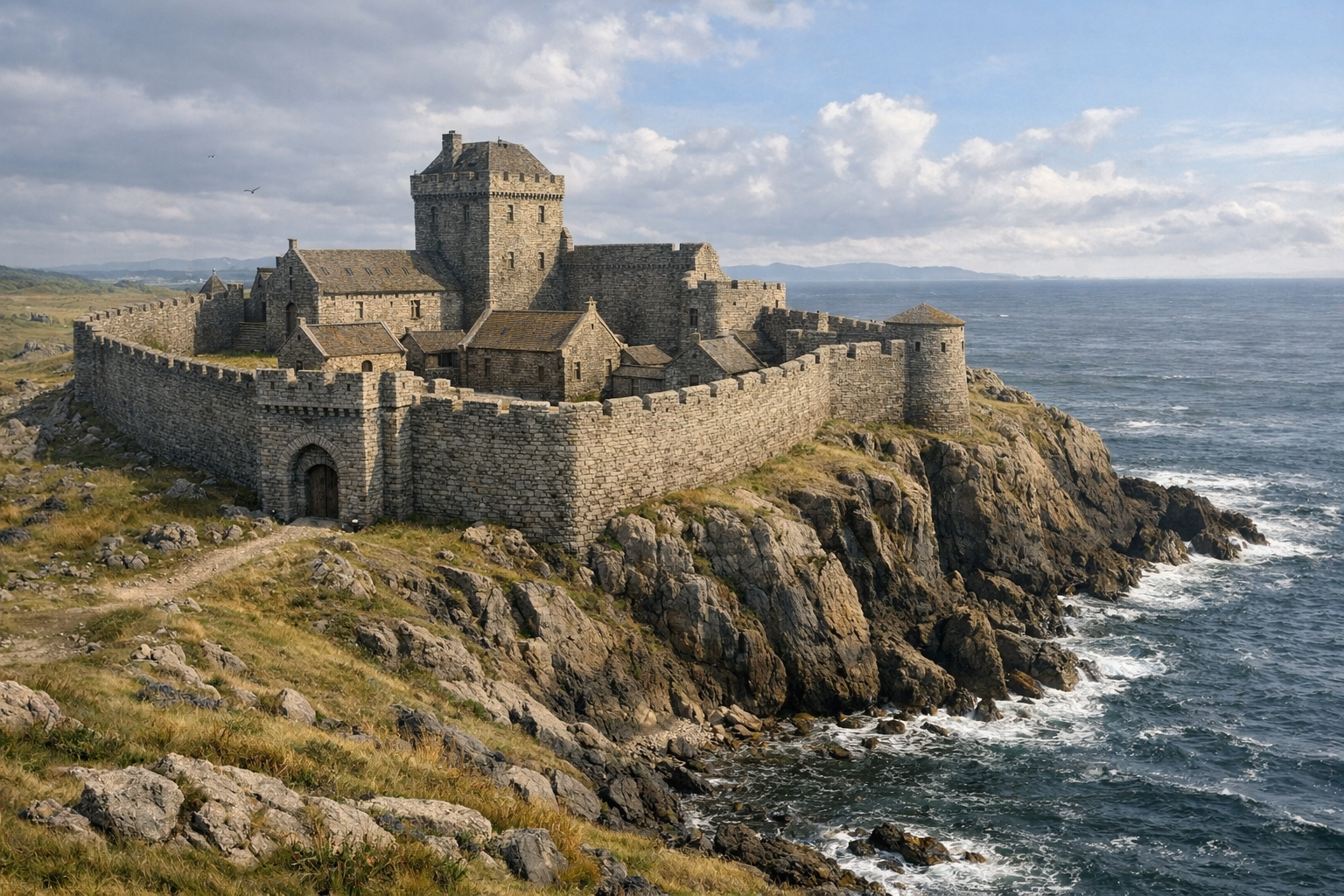
Turnberry Castle was almost certainly built by the Earls of Carrick, beginning with Donnchadh (Duncan), 1st Earl of Carrick who reigned from 1186 to 1250. Niall, 2nd Earl of Carrick would have expanded the castle by adding domestic buildings and maybe repairing and strengthening the rock walls. This would be the Turnberry Castle that Margaret, the Countess of Carrick, was born into. Her father Niall, died in 1256. Margaret succeeded him as a minor, meaning she was under 12 at the time. My family tree says she was born in 1252.
From 1256 to 1271, Carrick was governed legally by King Alexander III, practically by an English Crown‑appointed guardian and local Gaelic nobles. King Alexander III was only 14 himself and would not have been in charge.
Here I have to insert an important fact. I stated up front that this was a story of a Gaelic woman and a Norman man, but the faded truth is that Margaret was the g-g-granddaughter of Fergus who had married Elizabeth Beauclerc. Elizabeth was one of the many illegitimate children on Henry I, King of England and son of William the Conqueror. So, she was a faded Norman. Despite being illegitimate, Elizabeth was carried as a Princess. Recognizing that fact, Margaret the Countess of Carrick had Norman royal blood, Gaelic blood from Fergus, and local Carrick Gaelic lineage. She was much more than a regional countess.
Margaret was under royal supervision until age 12 after which she would have begun to attend royal gatherings at Ayr, Stirling or Edinburg. It is probable that she met a young man named Adam from Kilconquhar, Fife at such a royal place. Fife was about 140 miles east of Carrick and a good 6 days of travel away, so any meeting would have to be neutral territory. They could have met in person at a gathering as he was active in court and in military affairs as a young knight. By the late 1260s, Margaret was a young heiress ruling Carrick in her own right. The Crown wanted her married to a loyal knight and Adam de Kilconquhar, a Fife knight with royal favor, was a fit. The match was probably arranged through royal or noble intermediaries, not a personal courtship other than court association.
Their marriage took place before 1269, likely in Carrick or Ayrshire. Adam then became Earl of Carrick jure uxoris.
Adam’s father was Duncan of Kilconquhar who was a grandson of Duncan, Earl of Fife, an influential family of Scotland. Adam was a knight of standing which means he could have served the Earl of Fife or Alexander III or perhaps the Bishop of St. Andrews.
They had a daughter, Marjorie, which suggests he did have a brief domestic life. A guess is that Adam was born around 1244, so he left at 26. Adam was chosen to accompany Edward Lord on the Ninth Crusade. He departed in 1270.
His daughter Marjorie carried the Carrick line into a completely different branch of Scottish society. Her descendants include the Kennedy families of Carrick and the Crawford and Campbell lines. I have an ancestral line from her.

This section of the blog is focused on the Ninth Crusade, the one Adam of Kilconquhar participates in with Edward, (soon to be King of England), a Brus son named Robert, my oldest known Walker ancestor from Devon and many others who we will name. Facts, although limited, will be forthcoming with many assumed or derived conclusions consistent with the times. A scribe didn’t detail this quest that happened 745 years ago. We go through this blog basis my personal need to know of certain working details of a complicated crusade. This is my personal version, don’t put it in Wikipedia.
A young knight from a prominent Fife family, and is now a Carrick lord with means receives this parchment from the Scottish King in favor of Edward Lord, son of the King of England Henry III.

The wording could add “You shall be at Dover on the feast of Saint Michael next coming, ready to cross with us into France, there to join the company of our most Christian cousin, Louis, King of France, and to proceed with all haste toward the aid of Acre. Fail not as you hold your lands and honors from us.” The message could further add, “Christian Crusaders must regain possession of the Holy Land, mainly from the Muslim people. You should be reminded that these significant events emanate from the voice of the European nobles, the Holy Roman emperor, and the religious leaders who vowed to retrieve the Holy Land after the fall of Jerusalem centuries before.
No one of Adam or his family’s stature would turn away from this request. He had the invitation, the means, the skill and he was going and he would provide his own armor, horses, squires, retinue and passage. He would be gone for years, and the costs would be up to 5 years of income.
Typically, well outfitted Knights traveled with a warhorse, a riding horse, packhorses, squires and several men at arms. Adam probably didn’t have this much retinue buy we certainly do not know. Edward gathered his men most likely in Dover in 1270. Adam would ride south through the Lowlands, cross into England at Berwick and continue to Dover to meet the remainder of the English and Scottish crusaders. The travel time would be over a week from Carrick to Dover. The plan was to meet Edward’s forces at Dover, cross the canal, horseback to the French port of Aigues‑Mortes and sail with the French to Tripoli. This travel time required great patience. After arriving at Dover, Adam would have at least 1 week of mustering, 2 days to cross the Channel, 2 weeks riding through France on horseback, 2 weeks waiting on ship at Aiques-Mortes and another 6 weeks sailing to Tripoli.
The makeup of this crusader army was much smaller but more elite than the others. Probably makeup was 250 Knights, 600 men-at-arms and squires, 1000 archers and foot soldiers for a total of 1850 strong. They sailed to Tripoli, arriving in May 1271.
The fleet had to be substantial, likely consisted of 20–25 ships, which would be made up of simple transports for knights and their horses, supply vessels for grains and arms and the Galleys for men probably hired from Marseilles. Each ship carried over 40 men and less than a 100.
Edward was not king but was Duke of Gascony and he had income from there. Using his household revenues, loans and pledges, he financed a portion of the venture. It was expensive for him. Henry III provided a partial subsidy and some logistical support. Pope Clement IV and later Gregory X provided donations, subsidies and a share of the crusading tithe. Louis IX paid for some provisions, the fleet to Tunis and transport costs from Aigues-Mortes. The Knights Templar and Hospitallers provided credit and provide supplies in Acre.
Known Knights participating include Otto de Grandson, John de Vescy, Hugh de Turberville, William de Valence, Thomas de Multon, Ralph de Monthermer, Robert Tiptoft, John de Burgh, and Henry of Almain. Adam de Kilconquhar is the only Scottish knight definitively recorded on the Ninth Crusade.

A necessity for success in the Holy Land for any crusade is the Knights Templar (Order of the Temple) and the Knights Hospitaller (Order of St. John). The Knights Templar were monk-knights who were bound by vows and were answerable only to the Pope. They were elite soldiers and were financially savvy to have developed an international banking system. They were to provide supplies and safe storage for his funding and provide military support. This group was experience and could help defend Acre and coordinate inland raids using their local knowledge. Their objective was to protect Christian pilgrims traveling to the Holy Sites.
The Knights Hospitaller began as a hospital order but developed into a powerful fighting force with heavy cavalry. They ran hospitals, fortresses and fleets across the entirety of the Mediterranean. They answered only to the Pope.
The Pope granted the Hospitallers annual subsidies from church revenues and crusading tithes. During the Ninth Crusade, the Papacy distributed crusade funds to both the Templars and Hospitallers for logistics, ships, and supplies. The Pope invested so heavily because the Hospitallers were reliable defenders of the Holy Land.
Tripoli was a safe Christian port north of their destination, Acre, so Edward’s fleet made landfall there. He met with Count Bohemond VI to gather information of Baibars’ movements in Acre. The Hospitallers had a hospital and center there so Edward consulted the Hospitallers as well. Edward was sure to have noticed tension between the Templars and the Hospitallers which would erupt in a few years.
The campaign sailed south within days, arriving at Acre in late May 1271.

In late May of 1271, Adam had been three months away from Carrick. He was in close range in close quarters often during this time. It was inevitable that he would make acquaintances and friends. Such a person was a fellow Scot who would introduce himself as Robert de Brus, of Annandale. There is no evidence of Robert and Adam together on crusade, but everything about their social world makes their acquaintance highly probable.
Carrick was a Gaelic earldom, and Annandale was a Norman barony. They were 65 miles apart but not the same politically nor the same geographically. They held different political weight in the eyes of both the Scottish king and the English king. But were about 26-27 years of age and both considered Knights.
Robert’s father was the husband of Isabel de Huntingdon who was tied to English lands and English royalty. His father managed both Annandale and the English estates at Cleveland and Yorkshire. Politically he was tied into both Scottish and English crowns. Isabel died before 1254, meaning Robert had been a widower for nearly 20 years by the time his son left on the crusade.
William de Kilconquhar, Adam’s father, was a local knight of good standing who had regional but not nation influence. The Kilconquhars served their superiors with baronial authority.
While Adam was on crusade, Margaret was ruling Carrick, politically, militarily, and administratively as a powerful woman in Scotland. Turnberry had to be maintained and there were motherly duties to infant Marjorie.

Around 1220 AD, a Kipchak Turk boy was born north of the Black Sea which would be modern day southern Ukraine. The Kipchaks roamed from the Danube to the Volga. His nomadic steppe people were known for horse archery, mobility and a warrior culture. Baybars was brought up in the tough environment. His people were often targeted by slave-raiders who supplied the Islamic world with military type slaves. Before 14 he was taken by Mongols or these slave-traders who took him the Crimea for eventual sale to Egyptian or Syrian buyers. Baybars was taken to Egypt and soon entered the Mamluk military system there where enslaved boys were trained as elite soldiers. These boys were converted to Islam and trained in archery, swordsmanship and horsemanship. The total time to complete total emersion into this system was about six years and after that, they were free but by now were bound by loyalty to his military community. He now was called simply a Mamluk.

He fought in the Seventh Crusade and the Mongols at Ain Jalut in 1260. He was experience, successful and commanding and it quickly led to Baybars becoming Sultan of Egypt and Syria. His name became Baybars (al‑Malik al‑Ẓāhir Rukn al‑Dīn Baybars al‑Bunduqdārī) al‑Malik al‑Ẓāhir Rukn al‑Dīn Baybars al‑Bunduqdārī.
In 1271 he had destroyed crusader strongholds at Caesarea, Asur and Antioch and now threatened Acre.
Pope Clement IV and King Louis IX of France saw Baybars as a severe threat that could erase the Crusader presence entirely from the Holy Land.
The Ninth Crusade was conceived as a small and elite counter to rally the Crusader states and to hold Baybar’s advance. The first move was to reinforce Acre.

Edward was born in June of 1239 at Westminster, London and was the eldest son of King Henry III and Eleanor of Provence. At the beginning of the 9th Crusade, he was 31. His great-great-grandfather was Henry I the youngest son of William the Conqueror. His great-grandfather Henry II was founder of the Plantagenet dynasty, so he was six generations from William the Conqueror.
At a young age a foundation was laid for knightly combat in that he was taught horsemanship, swordplay, grappling and lancing. Later he trained with royal household knights and Gascon/Poitevin cavalrymen. He married very young, 15, to Eleanor of Castile, and received Gascony from his father. This started him in political responsibility. A civil war rebellion against his father caught Edward playing a role at the Battle of Lewes and later the Battle of Evesham. This defeat of Simon de Montfort was followed by his efforts to stabilize the kingdom with barons.
It was recorded that he was passionate, quick to anger and highly competitive. He was deeply religious but at the same time politically shrewd. He was loyal to friends and harsh to enemies. In that age he was considered very tall, likely 6′-3″. This is where the nickname “Longshanks” began. Pictures of him don’t depict a handsome man. His hair was light and he had a narrow, long face with a sharp nose.
Both adversaries, Babers and Edward, were strong leaders and well trained militarily. Baybars did not bring his entire force, yet he commander an army of up to 15,000 men at Acre. Edward arrived with barely 1000, yet his presence with the quality of his knights forced Baybars to pause and negotiate.
On June 20, 1272, at Acre, a man arrived at Edward’s quarters and claimed he had secret intelligence, wished to speak with Edward alone and wished to convert to Christianity. This should have been seen as danger, but Edward allowed him in. Once inside the man lunged at Edward with a short and curved dagger and sliced deep into an arm. Edward threw the man to the floor, wrestled away the weapon and killed him with the same knife. The cut became swollen and infected to the point that surgeons cut away infected flesh. Edward slowly recovered at left Acre on November 16, 1272. Five months later Henry III died, and Edward would become King of England.
The Scottish friends and knights on this crusade would learn in less than 25 years that Edward would be “Malleus Scotorum”, Hammer of the Scots. He spent decades trying to break Scottish independence by invading Scotland repeatedly, winning battles at Dunbar and Falkirk, stealing the Stone of Scone, executing William Wallace in brutal fashion, installing English to rule Scotland, and built garrisons to enforce English power.
What Edward would learn is that a Scottish knight in his company in Acre, Robert the Brus, would after another 56 years, have a son that would restore Scotland’s independence by defeating Edward I, winning Bannockburn, and forcing England to recognize him as king.
Adam de Kilconquhar died at Acre in 1271, between May and July, while serving with Edward. There are no details, but the conditions at Acre strongly suggest death from illness rather than battle. When a nobleman died abroad, it was customary for an ally to carry the news home to the widow or other kin. Adam died in Edward’s service and he would want the message carried home with dignity. Robert of Annandale would be the messenger.
The Mamluks under Baybars continued to pressure Acre but Baybars died six years later in the year 1277 which postponed the eventual fate. The Templars, Hospitallers, and Teutonic Knights fought each other leaving Acre with no centralized leadership and no help from Europe. In 1290, newly crusader pilgrims killed Muslim merchants in Acre. al‑Ashraf Khalil carried out the revenge by siege of Acre during April and May of 1291, nineteen years after Edward departed. The Mamluks had over 60,000 fighters and massive siege towers. The walls were breached after a brutal siege and the city fell on May 18, 1291. The Templars made a last stand in their tower but fail. After taking Acre, Sultan al‑Ashraf Khalil captured Beirut, Tyre and Sidon. The island of Ruad was the last crusader outpost that the Templars held. The Mamluks overwhelmed it in 1303 with a naval assault. This is the final engagement between crusaders and Mamluks in the region.

There would be no more crusaders, but Christian pilgrims could visit Jerusalem if they paid taxes and fees while being under strict supervision. The pilgrims could visit the Holy Sepulcher, Gethsemane and Bethlehem as well. In 1333–1342, the Franciscans were officially recognized as the Custodians of the Holy Land.
Makes you wonder why this wasn’t done to begin with and avoid the bloodshed and hardships between 1096 and 1272. Motivation? Leadership? Means? I guess it is easy for us to judge now.

In the winter at the end of 1791 and the beginning of 1792, Robert rode into Carrick. Likely his coming had been whispered to Margaret days before. He would tell her he had news from Acre and that Adam had died in Edward’s service. Absolutely Robert would have introduced himself as a knight who had traveled and fought with Adam. He would have stated he was from Annandale and was the son of Robert de Brus. She would understand the gravity of who she was talking with.
Robert would have been received formally, hosted as an honored guest, then questioned about the events of Adam’s time and death on the crusade. He would have been invited to stay a while for meals. While doing so, he would enter into conversations with others around her and see the estate and Turnberry Castle in its entirety. Margaret would observe his mannerisms, his character and his strength.
Margaret was a young widow with a daughter and with an earldom. Men of power were after her and she knew a husband would be chosen for her at some time by the Scottish royalty.
Within days, she invited Robert into her chamber. This was a Gaelic legal act as she knew he would be her husband. In Gaelic law, if a woman of rank brought a man into her chamber and he didn’t force his way out, they were considered within a binding marriage. This was consensual.
This was a strong, courageous and brilliant move to marry Robert. She had not gotten permission from the Royal authority, had chosen her own husband, and granted a Norman Brus and earldom in Gaelic land. This would change Scotland. She was about 20 and made this bold decision.
Alexander III fined Robert for marrying Margaret without his consent. Margaret retained unusual autonomy for a medieval countess and continued as a political figure in Carrick. She issued grants in her own name, confirmed land rights. Robert was often at the English court and Margaret ruled Carrick. They had children: Robert the Bruce (future King Robert I) born in 1274, Edward Bruce (later High King of Ireland), Thomas, Alexander, Nigel and Christina.
Margaret died in 1292 and her son Robert (the future king) became heir to the earldom. Without this marriage between Margaret and Robert, Robert the Bruce would not have inherited Carrick, would not have power base to challenge for the throne and the Bruce dynasty likely would not have risen.
When Margaret died in 1292, the Earldom of Carrick passed directly to her son Robert, not to her husband Robert de Brus. In feudal law, if a title were held by the husband’s right alone, it would normally revert to him. Carrick didn’t, it followed Margaret’s bloodline, not Robert’s. The earldom was her hereditary property, and Robert had only a temporary legal status. When she died, his status ended and her heir, son Robert inherited. She was always the master of Carrick.
Margaret was around 40 at death. History shows no cause of death nor description of her final days. The burial location has no certainty.

Marjorie, daughter of Margaret and Alan, married Duncan Kennedy of Dunure. Marjorie became ancestor of the Kennedys of Cassillis.
From my personal family tree that I have built faithfully since 1973, which contains over 10,500 ancestors:
Christina Bruce is my 15th g-grandmother.
Descendants of Robert the Bruce and Edward I, Longshanks converge in my tree in James Murphy Jr. born in 1789, North Carolina, and the 3rd generation in America from Dublin, Ireland.
A line from Robert the Bruce goes to Edward Johnson who was born in 1649 in Aberdeenshire, Scotland and married into my Walker tree(whose own Walker lineage) also goes back to Sir William Walker of Devon who was knighted by Edward I.

The fall of Acre in 1291, the last Crusader stronghold, weakened the Templars’ purpose and political position. On Friday the thirteenth, October 13, 1307, King Philip IV of France ordered the arrest of every Templar in France. Templars were accused of heresy, tortured into confessions, and their property seized. Was this a money grab? Yes, it was a calculated financial and political seizure. The Knights Templar were enormously wealthy, but most of their riches were tied up in land, banking, and credit rather than piles of gold. When King Philip IV moved against them in 1307, their portable treasure and archives had already vanished. This left Philip with just a little land.
A few years later on March 22, 1312, Pope Clement V formally dissolved the Knights Templar. After dissolving the Order, Pope Clement V transferred most Templar land to the Knights Hospitaller. The fleet at La Rochelle vanished just before the arrests. The financial system just simply dissolved. The treasure disappeared in 1307 and has never been recovered.
The Order of Christ in Portugal absorbed the few surviving Templars which included their knowledge and archives. There may have been some portable wealth recovered. The order funded Henry the Navigator, Vasco da Gama and Pedro Alvares Cabral. The Templars’ heirs paid for the voyages that shaped exploration and the discovery of America.
