


This story begins in Seaham, Durham, England with the marriage of Thomas Ledbetter (1600-1658) and Mary Thomas (1603-1673).
By Y-DNA analysis, the Thomas Ledbetter line has Anglo-Saxon and Border Reiver DNA with strong clusters in Durham County, Northwest England and Northumberland into Scotland.
According to genetic studies, the Y-DNA Grouping (paternal line) indicates the Thomas Ledbetter line is a North Sea Germanic lineage. It is strongly associated with County Durham, Northumberland and Angle-Saxon settlements including the low Scottish Highlands. The cluster in America is extremely light, meaning one immigrant male to Virginia and no evidence of unrelated Ledbetter lines. This is why all American Ledbetters trace back to one man, Thomas Ledbetter who immigrated to Virginia in 1636. He was the sole progenitor of all American Ledbetters.
In the Virginia DNA cluster, results reflects intermarriage in Charles City, Prince George and Dinwiddie Counties. Common surnames in this cluster are Vaughan, Eppes, Worsham, Cheatham, Puckett, and Bass.
In the England, the DNA cluster is found mainly in County Durham, Northumberland, Tyne Valley and the Bishop Auckland region. This indicates that Thomas came from northern England and certainly not from London or the south. Common surnames are Robson, Hedley, Fenwick, Carr, Rutherford and Charlton.
In the Scots Border and Reiver Cluster were the surnames Armstrong, Elliott, Graham, Nixon, and Forster.
Thomas Ledbetter’s most likely original parish was Chester-Le-Street. His DNA profile is R-U106 >R-Z306.

Durham countryside
As far as Mary Thomas Ledbetter goes, the middle name used often (Molisse) is a myth and most likely a transcript error copied repeatedly over time. Use of a middle name was very rare and unlikely in that time period. I have deleted the Molisse from all my collections. There are no DNA data clusters to suggest that the Molisse name was real.
I was fortunate to have my direct line Ledbetter tree handed to me in 1973 by my great-Aunt, Lillie Mae Ledbetter (Melton/Sawyer) who was born in 1909 and was the daughter of my great-grandfather, Higgins Ledbetter. The tree had been built, corrected, and handed down over seven generations when she gave me the tree. It gave the name of each grandfather, birth and death dates, and the spouse. I trust this direct line as the information was handed down directly from generation to generation, probably recorded in family bibles. My dad had also told me stories over the years, some of which were of the five brothers who were the third generation (children of Henry Ledbetter). My dad’s sister, Aunt Edith Ledbetter Fortune, also told me stories from her childhood memories of the Broad River Ledbetter family from George Ledbetter/Lizer Murphy and Higgins Ledbetter/Lafaria Searcy. I also received confirmation of my findings from Stuart Nanney, married to Luther Ledbetter’s daughter, showing the true lineage back to Richard Ledbetter Sr. I am sorry that I am unable to map everyone’s line but in mapping my line, it will show you many of your same ancestors.
When this Ledbetter couple set out for the colony, they likely did not envision that they would edge up to the farthest west of the frontier and that their children would always strive for a new western frontier. The cover picture is a depiction of Appomattox Falls at Ft. Henry in 1658 when the Ledbetters planted tobacco within sight.
Here is my theory (which I personally take as fact) on why, how and when Thomas and Mary immigrated. This is somewhat circumstantial, but I think you will agree that it makes sense. First of all, there are no records of immigration of Thomas and Mary via normal immigration ports and ships. Immigration in this case had to occur on a private vessel, and I think that they transported on a tobacco schooner returning back to Virginia from Durham County. A man named Thomas Tunstall was an alderman of Durham County, England and had exclusive rights for selling tobacco wholesale in Durham. He had the monopoly of importing tobacco from Virginia to Durham. Thomas’s relative, Edward Tunstall immigrated to Charles City County, Virginia in 1636 with several passengers and his wife Martha Greenhill Tunstall. I think those referenced were Thomas and Mary Thomas Ledbetter and their 11 year old son Henry and they were fellow workers and friends. First of all, the Ledbetter family business in America was tobacco, The couple worked in Durham where the tobacco King, Thomas Tunstall worked. We know Thomas Ledbetter and Edward Tunstall knew each other and lived next to each other in Virginia as public records in the early colony show one transaction indicating that Edward Tunstall had sold 125 acres to Thomas (probably 1637 when Tunstall moved to Henrico Country.) Additionally, Thomas had received an additional 99 acres due to arranging transportation of Margary Lucus and Mary House to America in 1638. Governor Berkeley transacted with 224 acres south of the Appomattox River on April 29,1668 to Henry Ledbetter. By this time, Thomas had been deceased by ten years. Due to the fact that no immigration records have been found, nor land records until after 1637, it is my own personal theory that Thomas and Mary immigrated with Edward Tunstall and were possibly indentures for one year to Edward Tunstall to work off their transportation costs, then were they able to buy the land from Tunstall in 1637. Some have stated they were landed gentry and purchased land when they arrived. The immigration to raise tobacco with Edward Tunstall makes a great deal of sense especially when you realize the family business was raising and selling tobacco. This family moved southward as their finances improved, and lands became available.

The Ledbetters were Anglican-churchyard in Durham, England
Oddly enough, I read a document that Mary Thomas Ledbetter was compensated in tobacco for her keeping/helping Thomas Tunstall in the years near her death in 1673. Further details on this could be interesting. But it does support credence to the immigration story.
There are many incorrect family Ledbetter trees on social media. Much of this is from the naming of men during the 1600-1700 era. Generally, the first son was named after paternal grandfather, second son named after mother’s father, third son named after the father, and fourth son named after the father’s older brother.
In the Ledbetter line, the third-generation men were named Frances, William, John, Richard with the name Drury used randomly for generations.
The fourth generation began when Frances named his sons Charles, Henry and John, then William named his sons John William and George. John called his son Richard Benjamin Ledbetter and Richard called his sons John, Charles, William and Richard Jr. These fourth-generation men were all born between 1689 and 1720, with most around 1700-1704.
I will use the following as an example of the misinformation you will encounter. Many trees attempt to say Richard Benjamin Ledbetter born 1690 (the nephew of Richard I born 1666) as being married to Hannah Coleman. This is a clear example of the tree mistakes rampant. To add mystery, Richard Benjamin Ledbetter’s son was Richard Benjamin Ledbetter Jr., but on the internet, his grandson was Richard Britt Ledbetter III, (a question not a fact)? There is a clear message here: Richard Britt Ledbetter III was Richard II’s son are not in the line from Richard Benjamin Ledbetter. The “Britt” in Richard Ledbetter III’s name was only a nicknamed about his love for brandy. To compound the errors and confusion, trees on the internet show birthdates for Richard Benjamin Ledbetter and Richard Ledbetter II as August 12,1717. This is highly unlikely and most likely a gross error. My great aunt’s record show Richard Ledbetter III as the son of Richard Ledbetter II and that Richard Ledbetter III died in Georgia. So, the writings that say Richard Britt Ledbetter III is the son of Richard Benjamin Ledbetter Jr. are incorrect. Unfortunately, these men have been confused for a very long time.
Richard Ledbetter III (with nickname Britt) lived to be 103 years of age. He fought in the Revolutionary War and while he was away from home, an Indian raid killed two of his young daughters. Richard was falsely charged with being a Tory but was able to prove himself a patriot. He was a remarkable man, and it implores me to correct the errors rampant on the internet concerning his lineage. Richard III is not in my direct line, but his brother Captain George Ledbetter is.
The similarities in the Richard vs Richard Benjamin trees are remarkable, confusing and likely generated by errors being repeated via trees and internet postings. I know the Richard line is correct because of my great-aunt’s offering. The Richard Benjamin tree is sketchier.
Here is my rendition of those two lines: Henry Ledbetter–Richard Ledbetter I–Richard Ledbetter II (1716-1751?)- Elizabeth Ledbetter (1743-1767) married John William Chewming and the second line was Henry Ledbetter–John Ledbetter–Richard Benjamin Ledbetter Sr.–Richard Benjamin Ledbetter Jr. (1717-1751?) –Elizabeth Ledbetter (1747-1822) married John Williams. As you can see, there is great confusing around Richard Ledbetter II and Richard Benjamin Ledbetter Jr. For one, the birth and death dates are superimposed. They both had daughters named Elizabeth that married men with John William in their name.
There is confidence that the Richard I tree is correct with the uncertainty of Richard II’s birth and death date. There is much uncertainty of Richard Benjamin Ledbetter Jr.’s birth and death date as well as the name of his children. I will attempt to clear this up further but as I mentioned, errors have been compounded over the ages. You will have to purge your tree, use common sense, and use a timeline to obtain an accurate Ledbetter tree.

I have added a 3715 persons descendant-tree from Thomas Ledbetter (1600). This tree is on Ancestry and is entitled “Descendents of Thomas Ledbetter (year 1600).” There will be occasional additions to this tree as more information is available to me. I have not added many families past the early 1900’s because I do not wish to add a living person to the tree. Once a Ledbetter female married, I only carried to her grandchildren in the tree. It is not my intention to carry the tree to living descendants, but you should be able to find your grandparents.
By the time the fifth (5) generation was born, around 1720-1735, I roughly calculate there were 600 Ledbetter off-springs descending from Thomas, the first to come. The early families had six to twelve children. It did not take long for the line to grow.
The first five generations of Ledbetters in Virginia produced many males while other Ledbetter immigrants did not and their lines throughout generations ended without males. Thomas Ledbetter is the progenerator of almost all Ledbetters in America.

1st Generation in America
Thomas Ledbetter (May 11,1600-1658) – Mary Thomas (1603-1673)
There was a recorded land transaction from Gov. Berkeley in 1668 to Thomas Ledbetter, located south of the Appomattox River and between the current cities of Petersburg and West Petersburg, Virginia. A branch of the Appomattox in this area was called Ledbetter Creek for years. The first three generations lived here totaling over ninety years. Thomas and Mary were recorded as residing in Charles City County. In those early years, the county extended very westward.
This is the only specific land grant tied to Thomas Ledbetter was that Thomas Ledbetter received 99 acres in 1638 for sponsoring two female immigrants, one of whom was Mary House, later wife of Henry Ledbetter.

This is an ancient map of the settlements in Colonial Virginia. Thomas Ledbetter lived in the area marked at Falls on the southwest corner of this map. It was as far west into the frontier possible at the time due to treaties with the Native Americans.
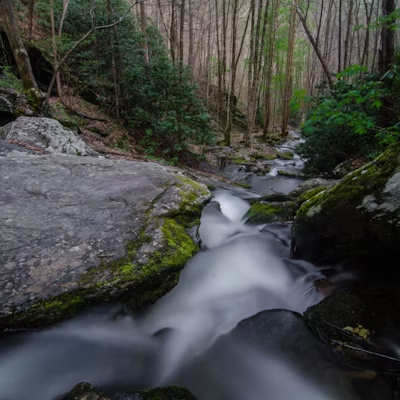
This is a picture of Ledbetter Creek inland before it falls into the Appomattox.

2nd Generation, children of Thomas and Mary
(1) Henry Ledbetter (1625-1698) – Mary House (1624-1672)
Henry Ledbetter settled as far west into the frontier as possible and was nearby Fort Henry on the falls of the Appomattox River. His sons were similar in that they migrated to the Meherrin River country, the new western frontier, around 1720. Mary House was transported to Virginia by Henry’s father Thomas. Doing tobacco business on the Appomattox near Ft. Henry was very adventagous for water shipment as many vessels supplied Ft. Henry and brought back tobacco when available.
John Ledbetter (1635-1698) could have been a second son of Thomas and Mary. We have no information. This is likely misinformation repeated through the years.
This is a big incorrect jump to assume the Charles City Henry Ledbetter was the same as the Massachusetts Henry Leadbetter. I have seen suggestions that the Massachusetts Henry was related to the Seaham family in some fashion but they immigrated to two different areas at two different times.
Also, the information I had handed down to me confirms that Mary House was the mother of all the boys and that Mary lived until 1672 in Virginia. This is proof that blindly following the tree some people post is not always true. The Virginia Ledbetters and the Massachusetts Leadbetters are not connected.

3rd Generation, children of Henry Ledbetter
(1) Francis Ledbetter (1653 -1743)- Martha Jones (1648-1745). Francis and Martha’s son John, born in 1699, married Frances Tedstall. Note that here is the Tedstall family again not the Tunstall mentioned above. There is a problem here again with names. William the brother of Francis had a son named John also and it has been recorded that this John married Frances Tedstall. Both Johns were born one year apart. On the following trees, I show Francis’s son John without a spouse name and I show William’s son John William as being married to Frances Tedstall.
The LDS genealogy confirms that Francis was the son of Henry Ledbetter and Mary House but incorrectly claims his birth year as 1660. I have a direct line to Francis Ledbetter and Martha Jones as well as Richard I. My line from Francis is through son Henry to his daughter Elizabeth who married Burgess Isaac Rowe Walton. Isaac and Elizabeth’s daughter Elizabeth Walton married into my Ledbetter line from Richard I. cousins marrying.

(2) William Ledbetter (1662-1743)- Rebecca Frances (1677-1756). A second source says Mary Frances Vandivers but Mary Frances Vandivers married his brother John’s son Richard Benjamen Ledbetter.

(3) John Ledbetter (1664-1750) – Elizabeth Livesay (1664)
John Ledbetter (1664–1730) appears to have been part of the earliest Ledbetter migration into Brunswick County, Virginia, during the first wave of settlement along the Meherrin River frontier. There is no information on him or Elizabeth.
(4) Richard Ledbetter I (July 4, 1666-1761) – The wife or wives of Richard Ledbetter I has not been fully resolved although I will offer my rendition. Richard’s first wife is possibly a Native American, a Siboney Indian and a second wife named Hannah Coleman based upon dates of his sons and the birthdate of Hannah.
This confusion started when old publications indicated that Richard was married to a native American, a Siboney or Meherrin. Most publications have him married to Hannah Honor Coleman. The two wive theory holds water if the first two sons were born in 1701/1703/1704 and the last sons after 1716. The crux is when was Richard II born? The date Richard and Hannah were married could carry great weight (see below).
A contributor to the confusion is Hannah Coleman’s birth date. Commonly it is listed as 1691 which would make her too young to mother the first two boys. It is possible that Hannah Coleman was born earlier, possibly 1682, which would make her old enough to mother all of Richard’s children. Note there was a twelve-year difference from Richard’s third son until his fourth son was born. If this were true, this is a marked indication that his first wife died young and he married Hannah later.
It also should be noted that Richard I’s sons, John and William, have no history. Could this be because they were from an Indigenousl marriage in the late 1600’s? There just isn’t much information.
There was an ancient publication “First Ledbetter in Virginia” that states that Richard Ledbetter Sr. married Hannah Coleman in 1715. This is a huge fact and cements the fact that Richard Ledbetter II was born in 1716 to Hannah Coleman Ledbetter. The older brothers were born to another mother.
So, I am choosing to believe a Siboney native American was married to Richard I first. Richard I married Hannah Coleman in 1715 according to colonial manuscripts. Hannah birth of 1691 seems more accurate.
Many people erroneously mark Richard I’s birthyear as 1690, but this is incorrect. Richard’s brother John had a son named Richard Benjamen Ledbetter who was born in 1690. As I indicated earlier, I have seen many trees and sites using this incorrect information.

The male children of William Arthur Ledbetter is an example of the beginning spread of descendants westward. Son William Buckner Ledbetter (1760-1840) moved to Overton, Tennessee and married “Cherokee” Jones. Son Rev/ Arthur Ledbetter (1798-1859) and Elizabeth Robbins (1821) moved to Dallas County, Texas. Son James Ledbetter (1804-1850) and Elizabeth Craig moved to Indiana.
(5) Drury Ledbetter (1667-1740)

(7) Martha Ledbetter
There are no records for Martha.
More information on Richard Ledbetter I (1666-1759)
Brunswick County was the western frontier in the years well after 1716. It is thought that Ledbetter brothers squatted on land there as early as 1716 but filed legally after grants were opened in 1720 and documented in 1722. Richard, brothers and their families moved to property adjoining each other not far from present day White Plains.
This property was in proximity to:
∗ both sides of the Meherrin River
∗ southward to Rattlesnake Creek
∗ near Fountain Creek
∗ near Swiss Creek, Little Creek and Hounds Creek
This is a view of the property layout which is within 12 miles of the Virginia and North Carolina border and east of White Plains, Virginia. In the heyday of the Ledbetter business in the White Plains area, mainly 1726 until Richard I’s death in 1761, there was a significant plantation settlement with a railroad depot. Now the area has been reduced to a Postal Center.

The families remained here until after 1770 when most moved on to new grants in North Carolina, primarily Rutherford County to Montford’s Cove. Richard I and Richard II had passed in the 1750-1760 range, and now a new generation began anew.
A mystery:
Further north, a Ledbetter Creek runs a significant distance south from the north Meherrin River and crosses Road 626 in Lunenburg County. Nearby is a church called Ledbetter Christian Church. In the adjacent graveyard lies Hannah Honor Ledbetter, wife of Richard Ledbetter I who we discussed above. This is the area inhabited by the many of the Ledbetter families from 1690 until 1729. This is just north of Moore’s Corner, Lunenburg County.
This was an area occupied by the majority of the Ledbetter families before moving south to Brunswick County in and around 1726 while some other relatives remained near Meherrin.

Also buried in this churchyard is Mary Vandivers Ledbetter, wife of William Ledbetter who was Richard Ledbetter I’s first son. Mary was buried in 1755 and Hannah in 1759. Mary was born Mary Williamson and her first marriage was to a Vandivers. Her birth year was 1706. The current church was built near these graves. No other burials occurred here until after the church was established in 1916. There was widespread smallpox epidemic in Virginia in 1759, and I surmise this may have taken Hanna in her sixty-seventh year. Many sources show Richard Ledbetter I also dying in 1759, but he was buried in an Episcopal Churchyard further south in White Plains. Some sites have Richard dying in 1761 which seems more feasible. There are conflicting dates throughout. Just another mystery, why were the two women buried here but all other kin southward? Why here when their home was southward? Mary Williamson was born into a Quaker family. Perhaps this preventer her from burial in the Episcopal Church?


4th Generation
I am jumping now to my direct line which was Richard Ledbetter II and Mary Walton, tree chart above. The building of the lines for all the other 4th generation lines is too exhausting.
One thing you would have noticed is that I listed William Arthur Ledbetter (1740-1804) as a son of Richard Ledbetter II and also a son of Private John Drury Ledbetter, a brother of Richard Ledbetter II. I haven’t found concrete documentation to decide the true line. The dates line up for each father. I tend to think John Drury Ledbetter due to the use of Drury in William’s line. The use of the name “Drury” was overused.
My line proceeded to Captain George Ledbetter (1742-1804) and Elizabeth Walton (1751-1801). Elizabeth Walton’s mother was Elizabeth Ledbetter (1730-1802) and daughter of Henry Ledbetter (1690-1751)/Edith Williamson (1690). Henry was the son of Francis Ledbetter (1653-1743)/Martha Jones (1648-1745). Captain George and wife Elizabeth Walton were first cousins. I have therefore lines to both Frances and Richard I, sons of Henry Ledbetter (second generation).

5th Generation
Before I continue with my line, I should write about Richard “Britt” Ledbetter III (1738-1841). Yes he was that old. He was the second son of Richard Ledbetter II.
Richard “Britt” Ledbetter III (1738–1841) spent his life on the edge of the southern frontier, moving from Brunswick County, Virginia to Granville County, North Carolina, and eventually into the gold‑country hills around Dahlonega, Georgia. Two of his young daughters were killed during frontier raids in the Holston region, a tragedy that shaped his decision to leave the dangerous borderlands and seek safer ground farther south. He was away fighting for the Colonist during the Revolutionary War when his girls were killed. Britt lived to the remarkable age of 103, remembered as a steady patriarch whose endurance carried the Ledbetter line through one of the most turbulent periods in early southern settlement.

George George Ledbetter moved to Rutherford County in 1775. A well-educated man who was involved with ratification of the Continental Congress. He also served as a Captain in the Battle of Kings Mountain under Colonel Hampton. He later served as a sheriff and Justice of Peace for Rutherford County after the Revolutionary War. He also fought at the Battle of Blackstock in Union County, South Carolina on November 20, 1780. Both he and his brothers were well educated. Richard Ledbetter II had likely hired competent tutors to teach his children. These families were well off for the times.
Here is the scene of Blackstock Battleground

and the grave marker for Captain George Ledbetter


6th Generation
Both Walton George Ledbetter and Nancy Temperance Ledbetter are in my direct line, cousins marrying again.
Walton George Ledbetter (1775-1866) married into the Goodbread family, an immigrant family from Germany. His wife Sarah Goodbread’s grandmother was Mary Ledbetter (1742-1825) who was the daughter of Richard Ledbetter II.
Mary Ledbetter (1742-1825) was initially married to John Bradley, but he fell from a barn loft while viewing a rare solar eclipse and passed away from his injuries. She then married John Goodbread, a German immigrant family initially called Gutbrodt. During the Revolutionary War, John Goodbread, his two brothers and his father, were Tories who supported the English King. The Goodbread family fought at the Battle of Kings Mountain with British commander Patrick Ferguson. The Goodbread brothers were captured after the Colonial Patriot forces defeated the British. They were convicted of treason in 1782. Rather than being executed, they had all possessions and properties confiscated. During the trial, it was found that there was no record of pay from the British or Tories to John Goodbread. He was allowed to join the American forces and had his property reinstated. John Goodbread amassed over 700 acres of land and significant wealth before his death in 1812-1814.
One of John Goodbread and Mary Ledbetter’s son, Captain John Goodbread, served as a Captain in the War of 1812 for the United States. After the war, he moved to Tennessee.
When I showed my father the Ledbetter tree in 1973, he remarked “So that’s how the Goodbreads got into the family” . I don’t know what he meant by that, but he was familiar with the name.
Walton George Ledbetter and wife Sarah Goodbread lived in the Montford Cove area of McDowell County.

Nancy Temperance Ledbetter (1784-1840) married William James Murphy (1789-1848) and their life and descendants built and defined the Broad River Community as well eastward. I will cover their story in detail to follow. The story is complicated as it involves politics, grants and money. The story will involve several generations. I may double track some history as I proceed because of the complexity of this story.
The roots of Broad River Community from my research began with simply four families. This involves an immigrant Dr. Joseph Dobson, born in London, England in 1720, another immigrant Murphy family from Ireland around 1718, the Ledbetter family of this blog and the Garrison family.
Dr. Joseph Dobson immigrated from England to Virginia in 1760. He moved to Burke County, North Carolina before the Revolutionary War. He served as a surgeon and Captain during the war with his sons Captain John Dobson (killed at Battle of Ramsour’s Mill) and Captain Joseph Dobson Jr. Dr. Dobson was the first university trained surgeon in North Carolina. Most important fact of all is that Dr. Dobson became the first recorder of Deeds in Burke County, North Carolina. He drowned in the James River in 1791 after a visit with friends and fellow patriots.
Archibald Murphy (born 1650), his son James Murphy (1695-1762) and grandson Timothy Murphy (1720-1783) immigrated to York, Pennsylvania around 1725 from Down, Ireland. Timothy married Joanna Bowker in 1745 and they had many children (over 12). One child was William John Murphy (1760-1838). John Murphy married Mary Catherine “Hazy” Dobson. She was the daughter of Dr. Dobson discussed above. Their son James Murphy (1789-1848) married into the Ledbetter family, Nancy Temperence Ledbetter (1789-1870). They were well established financially before the land grant boom.
Burke County was established in 1777, and Land Grand offices were created. In the first year, 1778, over 6000 land grants were recorded. The grants were usually 640 acres each. To obtain a grant you must settle and make improvements after other provisions were made such as mark land, enter into Land Office registry, survey the land and go to the Entry Taker. Remember who was the first Recorder of Deeds in Burke County? Dr. Joseph Dobson Sr.
Those who gained the largest of grants were veterans of the Revolutionary War. Privates received 640 acres, Captains 3840, Colonels 7200, Generals 12000 and Surgeons 4800.
In 1791 there was separation of the large Burke County. Edward Buncombe represented Buncombe County, David Vance represented Burke County and William Davidson represented Rutherford County.
In summary, Dr. Joseph Dobson was a surgeon and Captain during the Revolutionary War and Director of Deeds. Timothy and William John Murphy were in the war, and Captain George Ledbetter fought in the war. Land grants earned were:
Walton Ledbetter (son of Captain George Ledbetter) 3671 acres jointly held.
James Murphy (husband of Nancy Temperance Ledbetter), son of William John Murphy, veteran, and grandson of Dr. Joseph Dobson, received 30,000 acres from 1790 thru 1827.
William Murphy, son-in-law of Dr. Joseph Dobson, received about the same as his son James.
Dr. Joseph Dobson and his son Joseph Jr. received over 90 grants with each of them around 2700 acres from 1783-1804.
The gist is that the couple of James Murphy and Nancy Temperance Ledbetter were quite wealthy via their parents. These two built the High Porch Inn/tavern near what is now Hwy 9 and Chestnut Hill Road. This is generally near the Charles Fortune farm and is regarded as the headwaters of the Rocky Broad River or the origin of the British Broad River, shortened to Broad River. The span from Charles Fortune’s farm to Bat Cave (Fairview Road) is what we call the Broad River Community.

The Rocky Broad River
James and Nancy had a great deal of land in the area including the flat sections where fruit orchards thrived. This orchard area is where my dad was born and lived until around 1935. James and Nancy’s daughter Sarah Emeline Murphy (1823-1912) continued to live at the High Porch Inn after her mother’s passing in 1870. The inn was a stagecoach stop, and my ancestor George Ledbetter was a blacksmith nearby who repaired wagon wheels for the stages. After George was killed in 1864, his son Higgins became the area blacksmith at a very young age, possibly fourteen. Sarah Murphy met and married a stagecoach driver named William A. Garrison (1812-1893 when he was killed by lightening). This couple were the ancestors to the Garrison’s who lived in Broad River.
James and Nancy’s daughter Rebecca Eliza Murphy married George Ledbetter in 1840. LIza was Sarah Murphy’s twin sister.
Liza’s daughters became schoolteachers and married into Broad River families”
Katie Ledbetter (1845-1919) married Waitsill Lyda
Sarah Ledbetter (1848-1931) married James Gilliam
Katie Ledbetter (1852-1927) married Thomas Quincy Ledbetter
Rebecca Ledbetter (1860-1946) married William Albertus Garrison
Liza’s son Higgins (1862-1932) married Lefaria Searcy. They were my great-grandparents.

7th Generation, children of Walton Ledbetter

(1) William George (Washington) Ledbetter (1815-1864) – Rebecca Eliza Murphy (1823-1917)
George is shown by many people as George Washington Ledbetter (my own dad used this name) but George’s grandson Luther showed the name as William George Ledbetter in the family Bible (source Stuart A. Nanney). Stuart was the nephew of Luther’s wife Kate and was confident that the real full name was William George. The marriage bond on his marriage to Liza Murphy was simply signed “George Ledbetter”. I am using the name William George Ledbetter in my trees.
I have noticed that many people use George Washington (or Walton) Ledbetter born in 1826 in the Walton Ledbetter tree. This is not true. The George W. Ledbetter born in 1826 served in the Civil War in Company F of the 3rd Calvary. I do not know the identity of his parents. This George was not a son of Walton Ledbetter.

Thomas Quincy Ledbetter was the son William George’s brother Madison “Matt” Ledbetter, so Thomas Quincy and Mary Elizabeth were cousins.
My details on George Ledbetter were told to me by my dad and Aunt Edith who heard stories from their grandfather Higgins Ledbetter and grandmother Lafaria Searcy Ledbetter when they were children.
George was a very intelligent, educated skilled craftsman, blacksmith and farmer who provided food and support for those in the region who needed help. His wife’s family, the Murphy’s, had a wagon road inn, in fact his wife’s mother and father, Nancy Temperance Ledbetter and James D. Murphy, owned the tavern and lived in its quarters.
James Murphy’s mother was Hazy Dobson, the daughter of Patriot Dr. Joseph Dobson of Burke County who was a surgeon during the Revolutionary War and the conflict with the Cherokees. The Dobson family owned about 100,000 acres of land in old Burke County. This Murphy/Dobson pair was very wealthy. Perhaps the wealth came from both lineages.
George was handy with repairing wagons and wheels as necessary. When the inhabitants of Broad River began to have trouble getting food on the table, George provided abundantly for the valley. George also produced many grey pant uniforms worn by the Confederate troops. It has been stated that he had four looms working every day.

Eventually the building High Porch Tavern became the home of Sarah Emmeline Murphy (Nancy’s daughter) and William A. Garrison. William Garrison, former stagecoach driver, left Sarah for a while to venture in building a courthouse in Atlanta but it was a failure. After coming back home to Broad River, he was later struck and killed by lightening.
George and Liza were married at the home of Thomas Elliott who was married to Liza’s oldest sister, Mary Polly Murphy Elliott. George and Liza bought land in central Broad River Community from Bill Owenby. From James Murphy’s will, Liza’s wealthy grandfather, Liza had received considerable monies as inheritance. It is assumed that this was used for purchase.
George was over thirty-five at the outbreak of the Civil War, so he was allowed to continue farming while serving as a home guard instead of fighting front lines with Confederate units. He was a policing official for the Gerton, Bear Wallow, Chimney Rock, Broad River, Clear Creek and Edneyville area. This area was on the old Indian trail route from Spartanburg, South Carolina and later called Howard Gap Road which led to Fletcher to the west and Black Mountain to the north. Generally, members of a home guard unit would serve three months concurrently, then return to his home. I am not sure George was on extended duty at the time as his area of responsibility could be covered in hours on horseback from his own farm.
On April 13, 1864, George was shot in the head by a confederate deserter while on a mission with other home guards. In as much as he was buried at Clear Creek Township Cemetery, I believe he was killed near there. He was buried three days after death so he could have been moved there as well. The home guard unit was led by Capt. John Preston Fortune. He had ordered the deserters to stack their weapons and leave but shots were fired. After a brief fire exchange, the deserters threw down their arms and fled but not before George Ledbetter was mortally wounded.
Captain John Fortune had been a corporal in the 25th NC Infantry and fought in the east on many campaigns. He must have been wounded or partially disabled to be reassigned to home guard duty. John Fortune passed away the following year on June 11, 1865, at the age of thirty-nine. There is no information as if his early death was related to past injuries.

Captain Fortune
George Ledbetter’s wife, Liza Murphy (often called Lizer) had many young children at home which was about sixteen miles away. The youngest, my great-grandfather Higgins, was only eighteen months old. My Aunt Edith Ledbetter Fortune told me that Liza shot and killed the deserter. It is uncertain if the deserter was in home guard custody or whether Liza was with George when he was shot (which is doubtful considering the age of Higgins). Liza cleaned up George’s body and buried him. The death was a serious burden to the family and was felt for generations. His death was felt by many in the valley because of his massive contribution to it. It took a good ten years before son Higgins took over the blacksmithing work.
I do not know but I believe that treatment of a captured civil war deserter, who has just killed a beloved local policing authority, would be dealt with harshly.
Lizer Ledbetter was a skilled and energetic businesswoman who grew the family farm in acreage and assets. She raised the nine children by herself and sent four of the girls to college to become schoolteachers. Her business dealings were often assisted by her brother-in-law, Squire Thomas Ledbetter, called Thomas on documents. Lizer had black hair without gray for her entire 92-year life.
These four girls were the foundation for most of the descendants in the Broad River area. Rebecca Ledbetter married William Albertus Garrison. Their daughter Harriet Garrison married Emil Kirstein.
Catherine “Katy” Ledbetter married Waitsil Lyda, and their daughter Lena married James Wheelon.
Sarah Adeline Ledbetter married James Gilliam and their daughter Ida Gilliam married Olien Anderson.
Mary Elizabeth “Betty” Ledbetter married her cousin Thomas Quincy Ledbetter.
Rebecca Eliza Murphy Ledbetter (Lizer) had a twin sister, Sarah Emeline Murphy, who married William A. Garrison as mentioned above. Sarah and Lizer both lived long lives. The twins were born on September 12, 1823, Sarah died on February 10, 1912, and Lizer died on March 23, 1917. Many trees incorrectly use Sarah’s birth and death date for Liza. Most trees I have seen use the incorrect dates. Use this data shown on the pictures below for your tree.


(2) Madison Ledbetter (1809-1889)- Mary Lyda

(3) Temperance Ledbetter (1816-1881) – Wade Hampton Hill
Children were Elvira Emaline Hill, Amanda Jane Hill (Stroup) and Nancy T. Hill (Scoggin)
(4) Squire Thomas Ledbetter – Malinda Gilliam
Squire Tom was not married to Zilla Murphy but got her pregnant not long before his marriage to Malinda Gilliam. Squire Tom paid William Bertus Murphy, who had divorced from Squire Tom’s sister Temperance, a sum of ten dollars to marry Zilla. Squire Tom then married Malinda and the pair experienced more than their share of misery and pain.
Squire Tom and Malinda lost four of their children during a 51-day period in the spring of 1859. On February 13, nineteen-year-old Mary Elizabeth died, followed by eighteen-year-old James W. on February 15. Six-year-old Alfred Walton died on March 16 and his brother Richard O. (11) died on April 6, 1859.
Squire Tom and Malinda’s oldest son John England Ledbetter served in the Civil War in Company H of the 29th North Carolina Infantry. He joined up in Asheville under Col. Robert B. Vance. At the Battle of Stones River at Murfreesboro, Tennessee on January 2,1863 he was killed in an assault with 5000 confederates under Gen Breckinridge. There were 10,266 Confederate casualties on that day. A questionable assault on Union cannons was the undoing of this unit at Stone River. The first cannon blast hit a fence and took out eighteen Confederates with it. This was likely John’s fate.
Squire Tom’s brother and neighbor George was killed by a deserter in 1864 as was described above.
Squire Tom’s second son, William Haynes Ledbetter, was a Lt. in the N.C. 25th Regiment during the Civil War. He became a doctor and had many offsprings. Dr. William died young also, 36 years old.
Three more of Squire Tom and Malinda’s children died before they were forty. Squire Tom Ledbetter outlived ten of his children.
John England Ledbetter (1837–1863)
Dr. William Haines Ledbetter (1838–1874)
Sarah Elizabeth Ledbetter or Mary Elizabeth Ledbetter (1840–1859)
James W. Ledbetter (1841–1859)
Thomas Ervin Ledbetter (1844–1860)
Martha Jane Ledbetter (1845–1931)
Richard O. Ledbetter (1847–1859)
Sallie Ledbetter (1850–1927)
Alford Walton Ledbetter (1853–1859)
Minerva E. Ledbetter (1855– )
Catherine Manerva Ledbetter (1856–1900)
Zellah “Zilla” Ledbetter (1857–1919)
Rachael Callie Ledbetter (1860–1892)
Johnson Ledbetter (1863–1934)

8th and 9th Generations


Higgins Ledbetter

Lafaria Searcy Ledbetter

left to right (picture around 1907): Higgins, Bryan, Sam, Lafaria, Liza, Aunt Harriet, Luther, John Long, Ethel, Jim and Grandma Lizer Murphy Ledbetter. No Cleet picture, Lillie May wasn’t born yet, and Sambo, born in 1905 died early in 1927.
The yet-to-be born Lillie Mae Ledbetter is my great aunt and the person who gifted me the direct Ledbetter lineage. Her second marriage was to Greg Sawyer, my dad’s employer who built houses. My dad and the Greg Sawyer crew built the Billy Graham house high on Montreat Mountainside.


The effects of the American Civil War on the 8th Ledbetter generation was tremendous in a bad way. Males born from about 1830-1847 either enlisted or were conscripted to serve state regiments. To honor the Ledbetter descendants that perished in the Civil War, I will list their names as well as the name of their parents. Note that of the Ledbetter descendants that served, about eighty percent died in combat, prison camp or by disease. There are twenty-eight of them which is a shocking number. There are some Ledbetter males of that generation I did not have information on and that could affect the death percentage. At any consideration, the amount of Ledbetter males that died is shocking.
Col. Daniel Alexander Ledbetter — 1825-Aug 29,1862 Manassas, Virginia Son of Abner Ledbetter and Sarah Ann Calhoun
William George Ledbetter– 1824-May 13, 1864, North Carolina- son of Walton George Ledbetter and Sarah Goodbread (story in detail above).
John England Ledbetter– April 28, 1837-Jan 2, 1863, in Murphreesboro, Tennessee- Son of Squire Thomas Ledbetter and Malinda Gilliam. John was in the second brigade and 29th NC Regiment, Company H, under Capt. Robert B. Vance. The battle was fought alongside the 3rd Georgia, The 9th Georgia and the 11th Tennessee regiments. Shacky decision making led to a charge on Union cannons. John was killed on the last day of battle.
James H. Ledbetter–1843-February 18, 1863, Parents unknown.
Joe H. Hill– Aug 10,1842-Oct 15,1861 Portsmouth, Virginia- son of Rev. Wade Hill and Temperance Ledbetter
Alonzo C. Ledbetter–1846 Georgia-Dec 2. 1864 Georgia – Served in Company C, 27th Battery Infantry- son of William Ledbetter and Elizer Barren
George J. Ledbetter–1837-death date not known- Served in 31st Alabama-son of Timothy Ledbetter and Charlotte Temple
Henderson Ledbetter–Jan 6, 1823-Jan 3,1862-Illinois-son of James Ledbetter and Mahala Dillard. Served in the Union Army.
James M. Ledbetter–1833 Tennessee-April 24,1864 Mississippi-Served in 1st Infantry-son of Isaac Willy Ledbetter and Sarah Burden
John Turpin Ledbetter–1832-May 19,1864 Farmville, Virginia-Arkansas regiment-son of John Ledbetter and Susannah Williams
Pvt. John Walton Ledbetter–1834-February 28,1864 Point Lookout, Maryland-Served in Company C, 34th NC Infantry-prisoner of war-son of Barzilla Ledbetter and Sarah Elliott
Pvt. Samuel Hampton Ledbetter–February 13, 1838-Ocatober 4, 1864 Maryland-Served in 16th NC Infantry-son of Barzilla Ledbetter and Sarah Elliott
Jonathan Ledbetter–1845 Georgia-September 23, 1864 Sumpter, SC-son of Joseph Henry Ledbetter and Deliah Davis
Pvt. Thomas J. Ledbetter–1835 Georgia-May 3, 1863 Spotsylvania, Virginia-son of Martin Gilbert Ledbetter and Dicey Tribble
Pvt. William Overton Ledbetter–January 12, 1840-August 24. 1863 Chancellorsville, Virginia-Served in 34th Infantry, Company C NC–son of Barzilla Ledbetter and Sarah Elliott
Note: From the above information, you most likely realize that three sons of Barzilla Ledbetter and Sarah Elliott died in the Civil War. Samuel and William Overton Ledbetter served in the same company and infantry as my great-grandfather William Harris Elliott. Will Elliott was also wounded at Chancellorsville, Virginia but recovered at home in Rutherford County, North Carolina. Will Elliott missed Gettysburg but returned later and serviced as a wagon driver for the artillery.
James Alexander Forrest–1836 North Carolina-May 1,1864 Richmond, Virginia-son of Alexander Forrest and Polly Taylor.
Pvt. Crawford Wheeler Gilmer-May17, 1840 Virginia-July 3,1862 Seven Pines, Virginia-served in 4th Infantry-son of Robert Gilmer and Jane Ledbetter
Pvt. John McDowell Harris- January 8,1831-December 13,1861-Stauton, Virginia-served in 16th Infantry-son of Zadock Harris and Mary L. Ledbetter
Pvt. John K. Raiford-1844 North Carolina-July 22,1864 Georgia-served in 4th Infantry-son of Robert Raiford and Caroline Spencer
Philip Thurmond-1830 Georgia-October 16, 1862-served in 13th Calvary-son of Philip Thurmond and Susan Ledbetter
Oliver Van Smith-1827 North Carolina-December 1864 Vicksburg, Mississippi-married to Zillah Ledbetter
John F. Spearman-August 31,1828 Pickens, Georgia-July 9,1862 Hanover, Virginia-served in 44th Infantry-son of Rev Gabriel Spearman and Martha Sarah Ledbetter
John L. Averett-1843 Georgia-February 7,1862 York, Virginia-son of John Averett and Mary Ledbetter
James Jones Bradley-1827 North Carolina-August 28,1863 Lauderdale, Mississippi-son of Richard and Arminta Bradley
Lt. John T. Chambless-August 27,1826- Georgia-September 9,1862 Cedar Run, Virginia-son of John D. Chambless and Obedience Ledbetter
Sgt. Murphy Elliott-1837-1865-served in Company B of 35th NC Regiment-son of Thomas Elliott and Mary Murphy
Commodore Decatur Epps-1835 North Carolina-December 20,1863 Murray, Georgia-served in 6th Calvary-son of James Epps and Rebecca Ledbetter
John David Ledbetter 1834-1862 was the son of Daniel David Ledbetter and Cherokee Native Cynthia Ann Doughtery Ledbetter. He was in the 14th Texas Calvary and died in battle at Murfreesboro, Tennessee.
Brigadier General Nathen Bedford Forest one of the South’s greatest generals and Calvary officer was the 6th g-grandson of Thomas Ledbetter. His line ran from Frances Ledbetter, son of Henry Ledbetter. He was wounded several times but survived the war.
I would like to recognize Dean Ledbetter who passed away a few years ago. He was the grandson of Luther Ledbetter and Kate Nanney. I met him when I was young while my father and I were visiting my dad’s Uncle Luther (who was Dean’s grandfather). Dean was five years older than me and lived closer to Hendersonville, so I rarely saw him. Dean was actively involved in Ledbetter genealogy and did a great job of providing information on “Find a Grave” memorials. We must credit Dean with a great deal of information about Ledbetter history.
